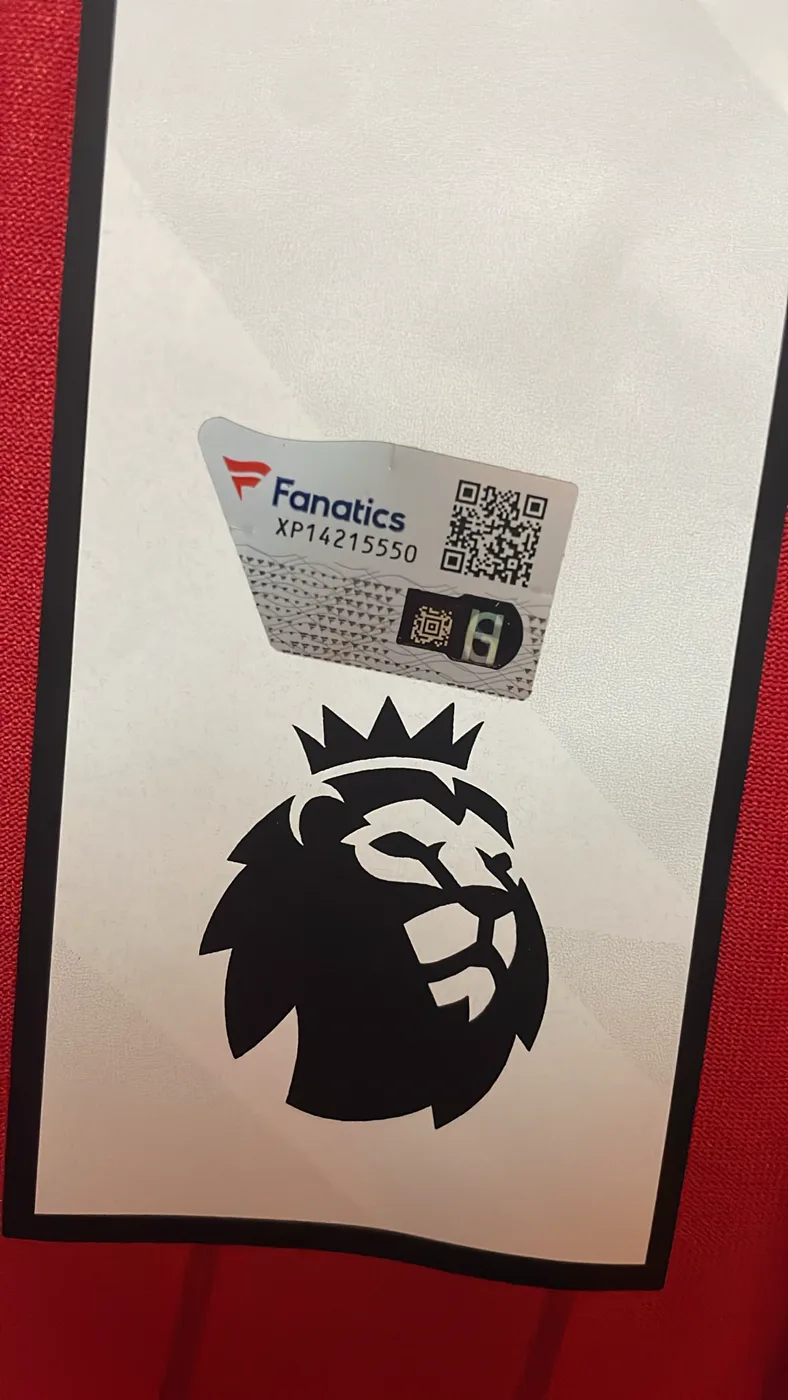
An autograph can transform how a football shirt is perceived, but it's also one of the hardest elements to assess with certainty from a distance, and one of the most frequently reproduced without authorisation. Understanding what really gives a signed piece its value — and what, instead, remains an unverifiable claim — is essential for anyone approaching this corner of sports memorabilia collecting, whether as a buyer or simply as a curious reader. This guide doesn't assess or certify any specific autograph: it offers a method for critically reading any claim of this kind, including those found in our own catalogue.
Why an autograph alone is never enough
The first thing to be clear about is that an autograph, taken in isolation from everything else, is not proof of anything by itself: not of its own genuineness, and certainly not of the circumstances under which it was supposedly signed. Footballers' signatures — like those of any public figure — have been reproduced, imitated and sold as genuine countless times over the years, often with enough care to fool an untrained eye. For this reason, a serious authenticity claim is never based on a photo of the signature alone, but on a set of verifiable elements surrounding it.
Authentication organisations
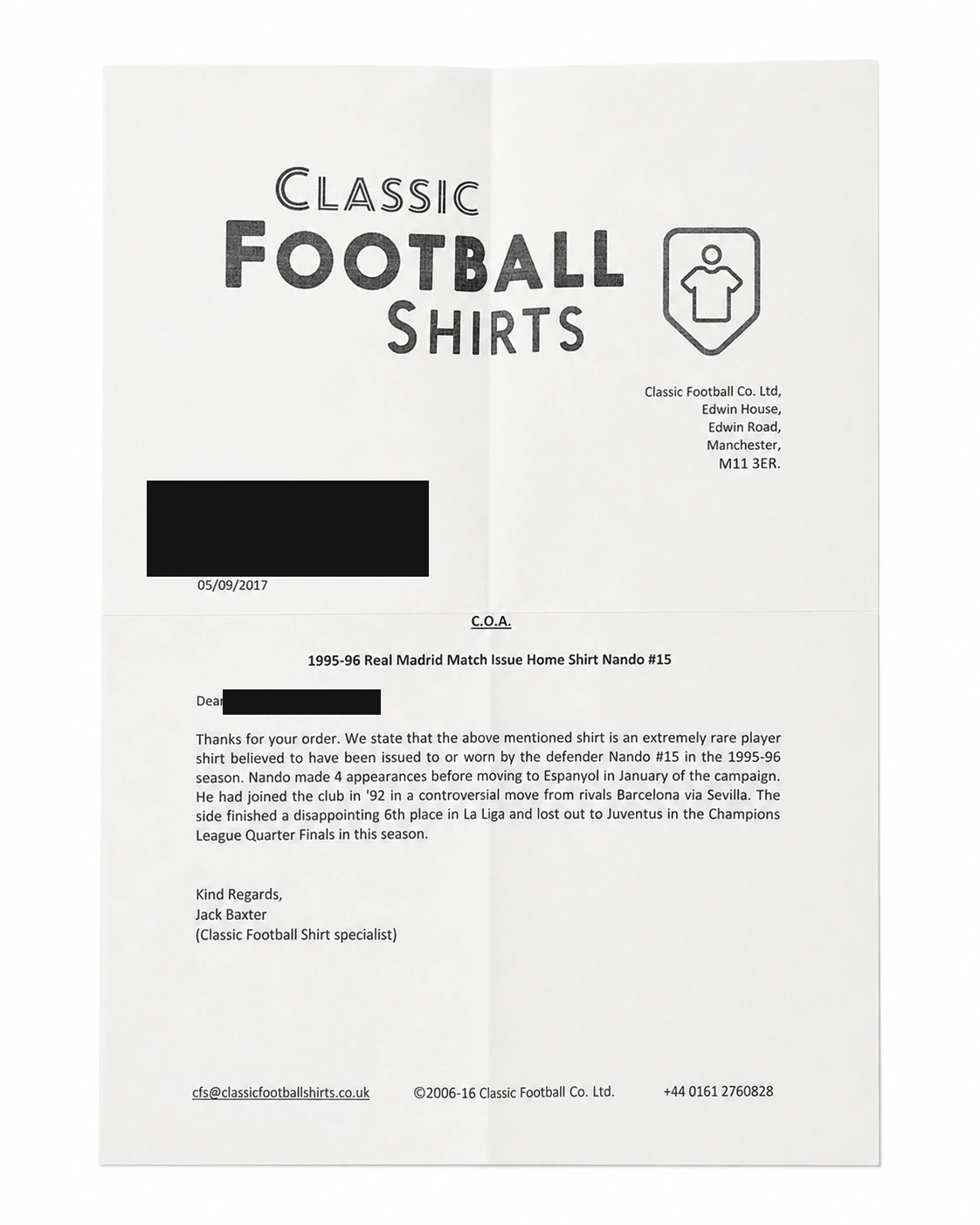
The sports memorabilia market includes third-party organisations that specialise in verifying autographs: they analyse a signature by comparing it against known, documented examples from the same individual, assess its consistency with typical style and pen pressure, and — when the outcome is positive — issue a certificate of authenticity (COA), often accompanied by a unique identification number that can be checked against a public register. It should be said clearly that the weight of such a certificate depends directly on the reputation and standards of the organisation issuing it: the industry has, over time, also seen lenient certifications issued with loose standards. A careful buyer checks not only that a certificate exists, but who issued it and by what method.
What sets a serious certification apart
A reliable certification generally has a few recognisable features: a unique serial number that can be independently checked against an online register, not just stated on the certificate itself; a specific description of the signed object (not a generic "football shirt", but the model, the size, the position of the signature); and, where available, photo or video documentation of the moment the signature was given, which is the most direct evidence possible. The absence of one or more of these elements doesn't automatically mean the autograph is fake, but it does lower the level of certainty that can reasonably be attached to the claim.
Signed on request versus signed in a sporting context
A distinction often overlooked concerns the context in which a signature was given. An autograph can originate at an organised event — a signing session, a fan meet-and-greet, a charity auction — with witnesses, photos of the event and sometimes the direct supervision of an authentication organisation on site: in these cases the provenance is often the strongest of all, precisely because it's documented at the very moment it happens. Different is the case of a signature said to have been given in a sporting context — after a match, in a dressing room, during a training camp — where direct documentation is often harder to come by, and provenance relies more heavily on the account of whoever obtained the signature, with all the limitations that entails.
The role of certification in overall value
A solid certification increases the confidence a buyer can reasonably place in a piece, but it isn't the only element that determines its overall value: the rarity of the player or moment represented also matters, as do the garment's general condition, the quality and placement of the signature on the fabric, and — where present — consistency with other documented elements, such as verified match worn or match issued provenance assessed by the criteria described in our dedicated guide to those categories. A signature on an otherwise history-less garment is still a signature; but a signature that fits coherently into a broader, documented story takes on a different meaning.
Warning signs worth noting
Certain signals always deserve further checking before going ahead with a purchase: a certificate with no verifiable serial number, or whose number doesn't appear on any publicly searchable register; a description of the item so generic it could apply to almost anything; a price noticeably below comparable pieces with solid certification, with no plausible explanation; and a seller unable to provide any additional information about the context in which the signature was supposedly given, beyond what's already written in the listing. None of these elements is definitive proof of a problem on its own — but their combined presence always justifies caution.
Why we always describe precisely what we can state
In an industry where trust is built over time and lost in an instant, the most responsible choice is always to clearly distinguish between what is documented, what is likely based on circumstantial evidence, and what remains simply asserted without verifiable support. This applies to any signed piece, wherever it's bought — and it naturally applies to our own catalogue too, where every description reflects exactly the level of certainty we can reasonably stand behind, never turning a possibility into a certainty just to make an offering more appealing.
An autograph with no verifiable context is just a signature on fabric. It's the documentation around it — certification, provenance, consistency with other elements — that builds its real value.Tifoso Infinito editorial note
Assessing an autograph with method means accepting that absolute certainty is rarely available, and that the task of a buyer — as much as of a serious seller — is to get as close as possible to that certainty through verifiable documents, not through trust in someone's word alone. It's a slower, less immediate approach than a simple photo with a caption, but it's the only one that, over time, genuinely protects the value — financial and historical — of a signed piece.