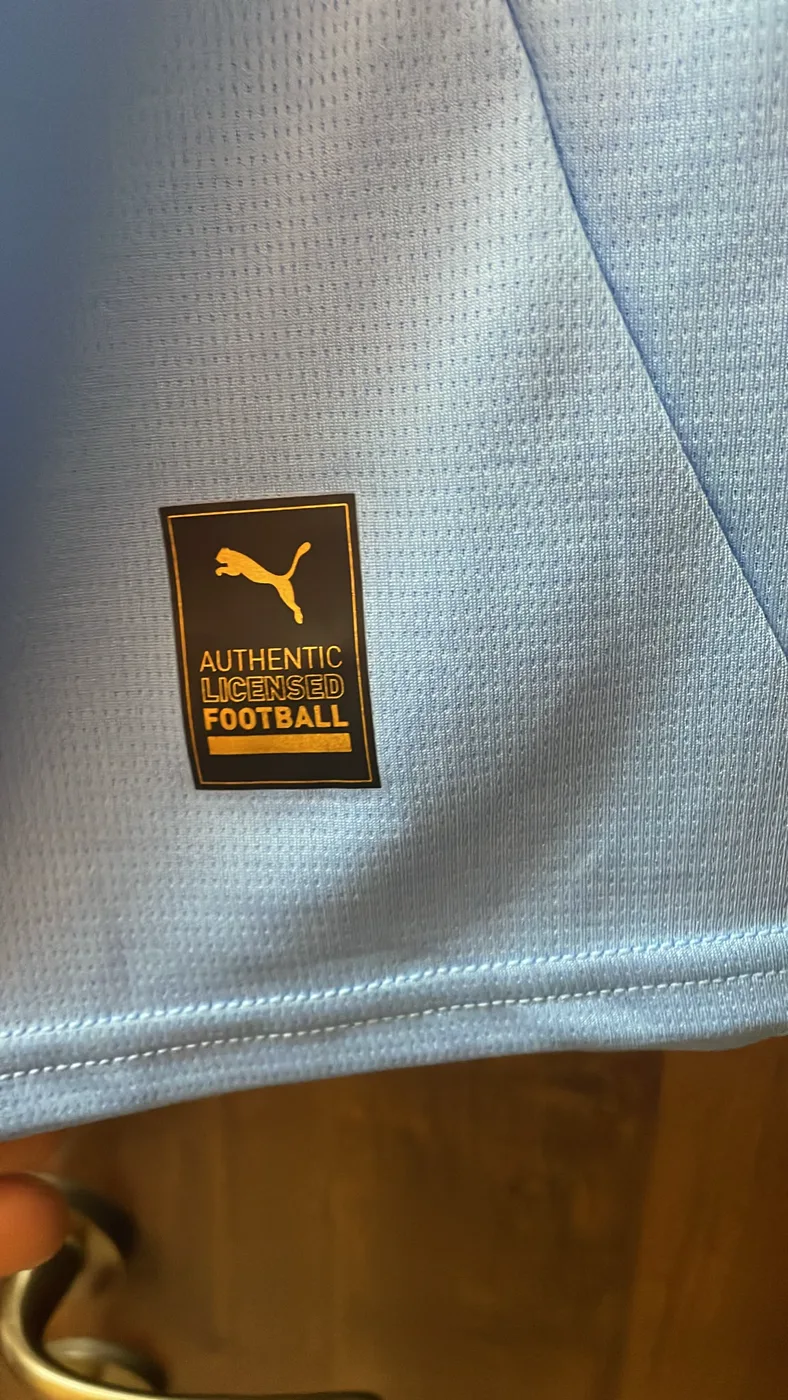
Anyone who collects or buys football shirts quickly runs into a question that sounds simple and never quite is: is this shirt original? The answer rarely comes from a single detail. A correct label isn't enough, a well-embroidered crest isn't enough, and not even a plausible product code is sufficient on its own. The authenticity of a football shirt is judged by the accumulation of consistent clues, not by one isolated element — and it's precisely this cumulative, cautious approach that separates a serious analysis from a hasty judgement. In this guide we gather the points that people who work with historic and modern shirts every day check first, without pretending to turn anyone into an expert in a ten-minute read.
Why no single feature is ever enough
Over the years, makers of high-quality replicas have learned to take ever greater care over individual details: cleanly embroidered crests, plausible-looking labels, tidy stitching. That's exactly why relying on a single element — "the crest is embroidered so it must be real", "the label has the right code so it must be genuine" — is as common a mistake as it is a risky one. A serious analysis cross-checks several signals at once: if even one element clashes with the others, the whole assessment needs to be revisited. It's the same principle that guides any appraisal of a collectible object, from coins to watches: internal consistency matters more than any single isolated detail.
Product code and style code
The major sportswear brands identify every model with a product code (often called a style code) printed on one of the inner labels, usually near the size. This code is specific to the model, the version (retail, authentic, player) and sometimes even the size, and can in principle be checked against period catalogues, product sheets or listings from official retailers of the same era. A code that's missing, illegible, or traceable to a different model or season than the one claimed is a signal worth attention — though on its own it's never definitive proof: codes can be copied with the same care as a crest.
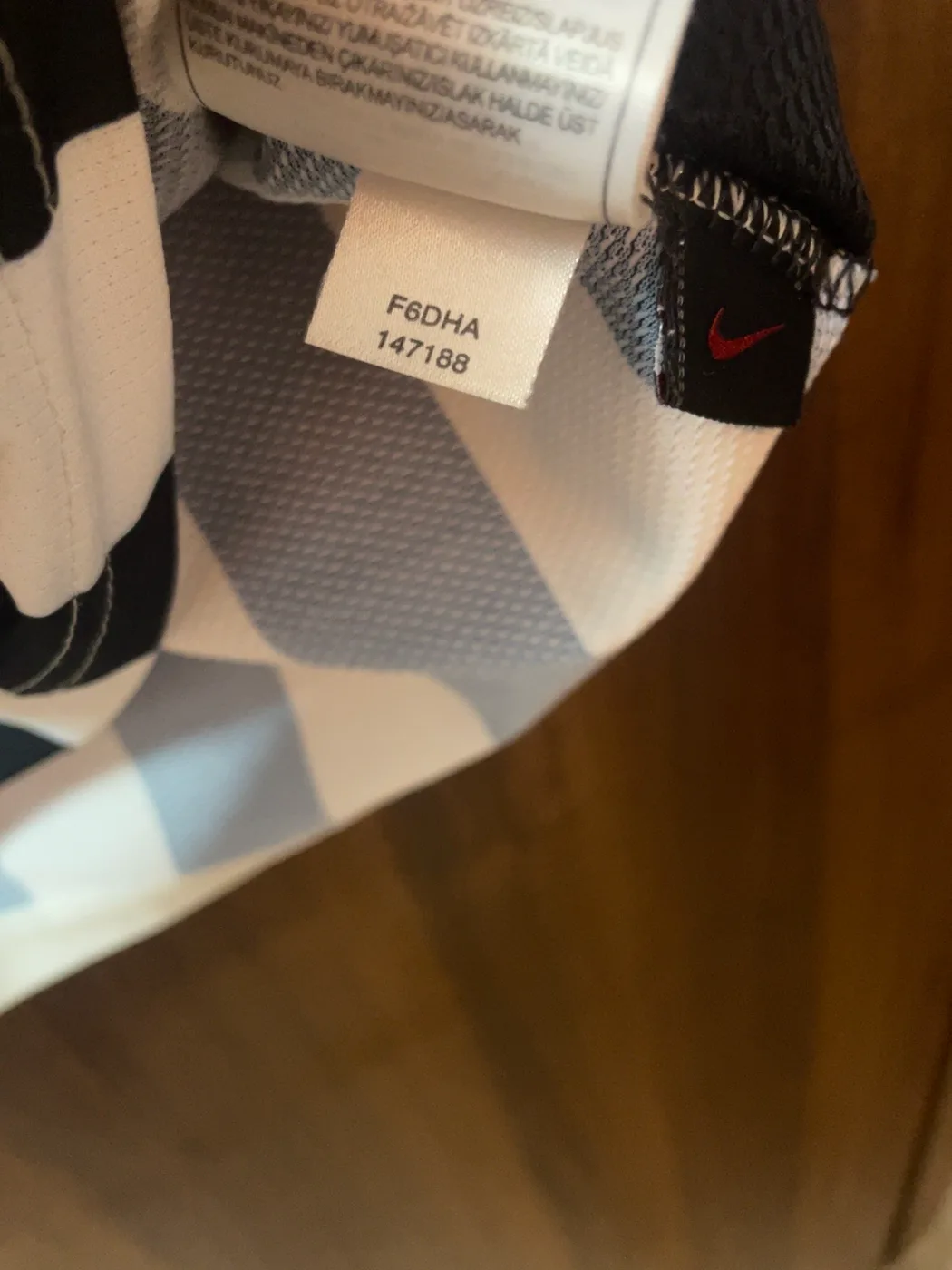
The inner labels
The labels — at the collar, on the side seam or on the hem — often carry more information than it seems: size, fabric composition, country of manufacture, and sometimes a serial number or a brand-specific verification code. Every era and every product line has consistent typographic conventions, materials and placements: a font that doesn't match, imprecise label stitching, or information (such as the country of manufacture) that's incompatible with what's known for that model and season, are details a trained eye notices immediately. Even here, though, caution is essential: labels on their own aren't enough, they need to be read together with the rest of the garment.
Fabric and stitching
Fabric tells you a lot, but it needs to be touched and examined in person more than described: fan/replica shirts typically use a simpler, less structured fabric, often heavier than authentic or player versions, which are instead built for on-pitch performance with technical fabrics, ventilation panels and a closer cut. The stitching on an original shirt tends to be regular and clean, without loose threads or obvious irregularities where panels join. Discontinuities in the fabric weave, colours that don't exactly match across different panels, or a fit that doesn't reflect the model's known proportions, are further clues to weigh alongside everything else.
Crests, sponsors and technical logos
The way a club crest, sponsor logo and technical brand logo are applied changes depending on the era and version: embroidery, heat-press application, or direct sublimation into the fabric (a technique increasingly common on more recent shirts). Each technique has a recognisable visual and tactile quality, and it's difficult to replicate perfectly across all three elements at once. It's also worth checking placement precision and proportions: official marks follow precise graphic guidelines, updated season by season, and small variations in shape or colour compared to a club's official colour codes can signal an unofficial reproduction.
The stated fabric technology
Nike, Adidas, Puma and the other technical brands each associate a specific era with a specific fabric technology, stated on the inner labels: Dri-FIT and later NikeFIT DRY for Nike at different points, Climacool and then HEAT.RDY for Adidas, Dry Cell for Puma, to name just a few examples. Finding a technology label that's anachronistic for the claimed season — a technology introduced years later, or already retired — is one of the most direct signals of a garment that doesn't match its supposed origin, because it requires knowing the precise timeline of each brand's technologies, information that's less readily available and therefore less often replicated with care.
Patches and namesets
Competition patches — reigning-champion badges, Champions League or Premier League patches, anniversary logos — follow precise rules about which shirts can carry them and in which season, often differing from league to league and competition to competition. A patch out of context, applied to a season or competition the club had no part in, is a mistake that's easy to spot if you know the club's history. The same goes for the nameset: the font, spacing and material of the personalisation have changed several times over the years and differ from league to league — a detail that turns every personalisation into a small historical document in its own right.
Retail replica, Authentic and Player Version: not the same thing
A very common mistake is to treat "original" as a single product category, when in fact technical brands have for years offered at least three distinct tiers of the same model: the fan/replica retail version, aimed at the general public, with simpler fabric and an accessible price; the authentic (or stadium) version, closer in cut and materials to what's worn on the pitch; and the player version, the cut closest to what players actually wear, often without the decorative finishing aimed at the end consumer. All three, when officially produced and sold by the brand, are "original" in the fullest sense of the word — but they are different products, with different characteristics, and confusing them easily leads to mistaken assessments.
The value of comparing against documented examples
No checklist replaces a direct comparison with already documented examples: collectors' photo archives, historic brand catalogues, completed listings from trustworthy dealers, specialist groups and forums where the same shirt has already been discussed by other enthusiasts. When a detail doesn't add up, the right question isn't "does it look plausible?", but "does it match what's already documented for this exact model, this size, this season?". It's a process of comparison, not intuition, which is why it takes time and patience rather than a single glance.
Common mistakes and warning signs
Certain signals recur more often than others among shirts that later turn out not to be original: a price noticeably below the market average for that model, with no plausible explanation; a seller who only shows generic photos or images lifted from other listings, and is reluctant to provide close-up shots of labels and stitching on request; vague descriptions that avoid specifying the exact version (retail, authentic, player); and the total absence of one of the inner labels expected for that model. None of these signals is proof on its own — but their combined presence always justifies further checking before going ahead.
Why photographs alone don't allow absolute conclusions
Even the most carefully shot photo session has limits that need to be honestly acknowledged: image compression flattens fabric texture, lighting can hide irregularities in stitching, and a single frame doesn't let you check the weight, stretch or hand-feel of the material — qualities that only come through when the garment is actually in your hands. For this reason, any assessment based on photographs alone — including those published in this very guide or in our catalogue — remains by definition a cautious estimate, not a certification: the soundest conclusions always come from direct comparison with the physical object, when possible, and from cross-checking multiple sources when it isn't.
No single detail proves a football shirt is authentic. It's the consistency across many different details — labels, fabric, stitching, logos, stated technology — that builds a solid judgement.Tifoso Infinito editorial note
Recognising an original shirt isn't a test with one correct answer, but an exercise in patient observation that improves with experience and constant comparison with other enthusiasts. It's the same approach — cautious, cumulative, never absolute — that we apply to every piece in our catalogue: we describe what we can verify, we openly flag what remains uncertain, and we never turn a plausible hypothesis into a stated certainty.