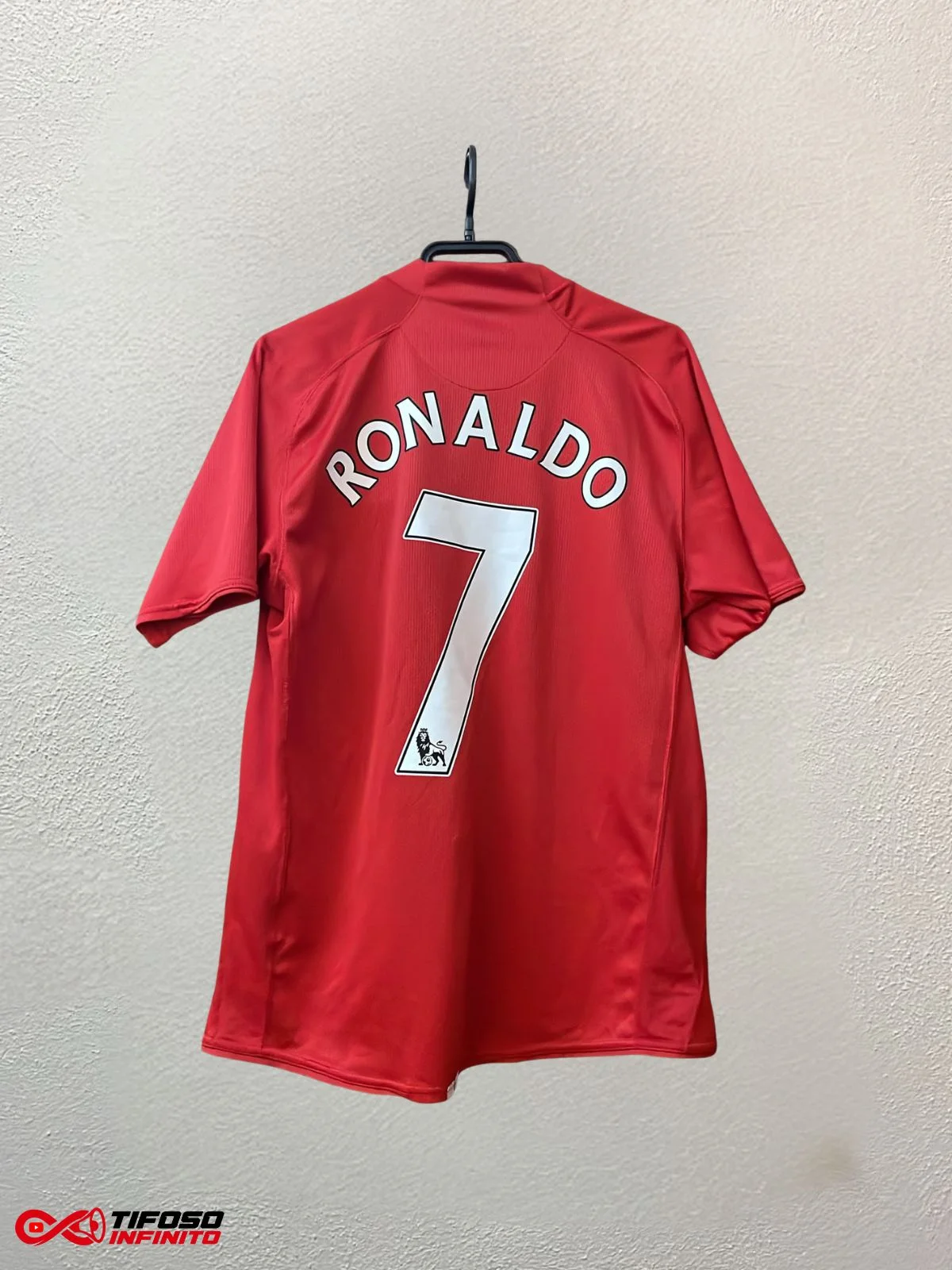
Some shirts tell the story of a season, and some tell the story of a definitive leap to the top. Manchester United's 2007/08 Home Nike shirt belongs to the second category: it's the shirt of the Premier League–Champions League double, but above all it's the shirt of Cristiano Ronaldo's number 7 in the year the Portuguese stopped being a promising talent and became, in every practical sense, the best player in the world. Forty-two goals in all competitions, a Ballon d'Or, a final won on penalties in Moscow: 2007/08 remains the high point of the first Ferguson–Ronaldo cycle, and this shirt — red, essential, with the AIG sponsor across the chest — is its most direct record.
Manchester United, 2007/08
Manchester United went into the 2007/08 season as reigning champions of England, having won their ninth Premier League title in 2006/07. Sir Alex Ferguson, in charge for over twenty years by then, could call on a squad built to compete on every front. In front of Edwin van der Sar, the defence relied on Rio Ferdinand and Nemanja Vidić, a settled central pairing, with Patrice Evra and Wes Brown on the flanks. In midfield, Michael Carrick, who had arrived the previous year from Tottenham, provided balance and passing quality, while Paul Scholes and Ryan Giggs — by then veterans and symbols of the club — remained central figures on the nights that mattered. Up front, the trio of Cristiano Ronaldo, Wayne Rooney and Carlos Tévez — who had joined from West Ham in the summer of 2007 — is remembered as one of the most devastating in Premier League history. That same summer had also brought in Owen Hargreaves and the young Nani and Anderson. The stated goal was to defend the title and go all the way in the Champions League too: the team closed out the season achieving both, with the historic double.
Cristiano Ronaldo's year
Over the course of the 2007/08 season — spanning his twenty-second year and his birthday on 5 February 2008, when he turned twenty-three — Ronaldo finally exploded. He closed the season with 42 goals in 49 appearances in all competitions: 31 in the Premier League, a haul that won him the league's top scorer award (the Golden Boot) and equalled the record for goals in a single 38-game league season, plus 8 in the Champions League, where he also finished as top scorer. It was also the year Ronaldo's repertoire was enriched with moves that would go on to become his trademark: headed goals despite a physique not built for pure aerial power, shots from distance, and an unpredictability in one-on-ones that Premier League defenders were increasingly unable to contain. On the individual honours front came the PFA Players' Player of the Year award, won for the second year running, the UEFA Club Footballer of the Year prize and, at the end of the calendar year, the 2008 Ballon d'Or — the first of his career.
Premier League and Champions League
In the league, Manchester United secured their tenth Premier League title — the club's 17th English championship — by winning their last two matches of the season: decisive on the final day was a 2-0 win over Wigan Athletic, sealed by a goal from Ryan Giggs, while Chelsea chased but could not overtake their rivals. The table finished with Manchester United top on 87 points, Chelsea second on 85 and Arsenal third on 83 — the slimmest of margins, settled only on the last matchday.
In the Champions League, the team went through the entire tournament unbeaten. In the last 16 they eliminated Olympique Lyonnais: a 1-1 draw in France in the first leg, with an equaliser from Carlos Tévez, and a 1-0 win at Old Trafford in the second leg, settled by a Cristiano Ronaldo goal, for a 2-1 aggregate. In the quarter-finals they knocked out Roma (3-0 on aggregate), and in the semi-final, Barcelona, edged out 1-0 on aggregate thanks to a 0-0 draw at the Camp Nou in the first leg and a Paul Scholes goal in the second leg at Old Trafford — a powerful strike from outside the box that has become, over the years, one of the most remembered goals in the club's recent history. The final, played on 21 May 2008 at the Luzhniki Stadium in Moscow, was the first all-English Champions League final: their opponents were Chelsea, managed by Avram Grant. Ronaldo put United ahead with a header from a Wes Brown cross, Frank Lampard equalised shortly before half-time; after the scores stayed level at 1-1 through extra time, the match went to a penalty shoot-out, won 6-5 by United. Ronaldo himself missed his spot-kick, but the team won regardless thanks to John Terry slipping and striking the post at the crucial moment, and to Edwin van der Sar — named man of the match — saving the decisive penalty from Nicolas Anelka.
The 2007/08 Home shirt
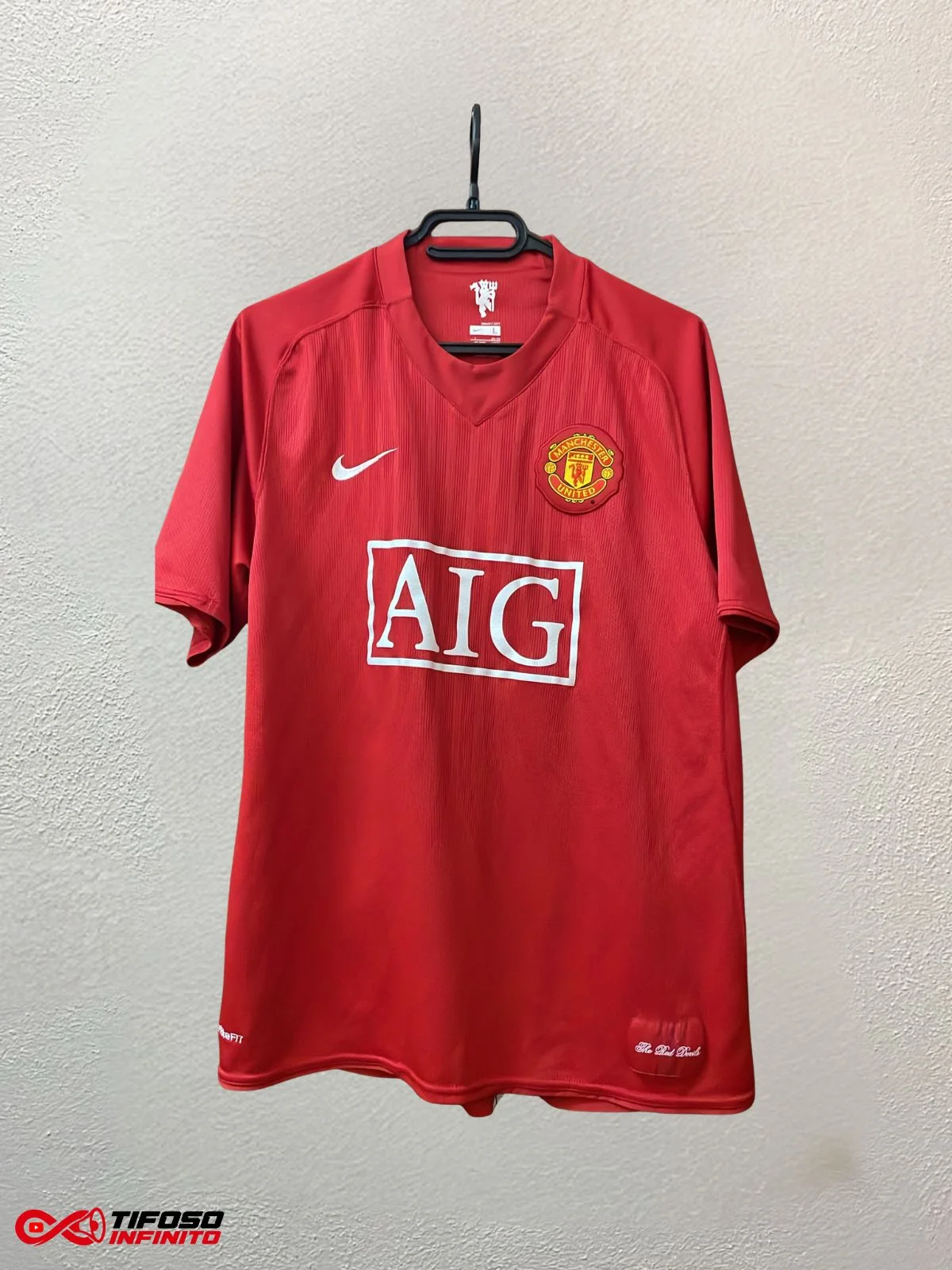
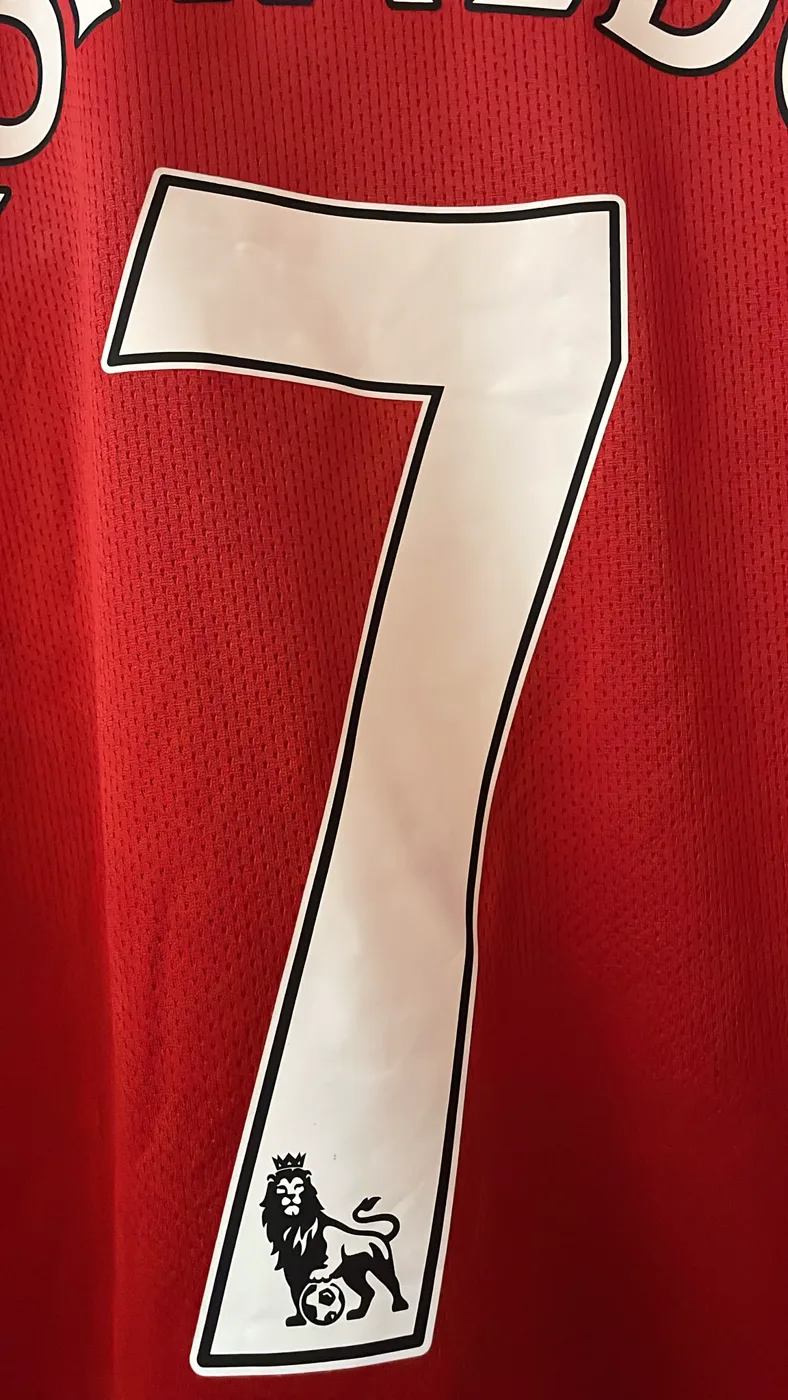
The Home Nike shirt worn that season — the same model, according to the garment's own specifications, also used in the following 2008/09 campaign — is among the most recognisable of the Ferguson era precisely because of its restraint: solid red, V-neck collar, a subtle vertical-stripe weave, without the bold graphics that would come to characterise other Nike shirts in the years that followed. On the chest, the Manchester United crest and the AIG sponsor, an insurance company that had arrived on the club's shirts the previous year in a record deal for English football at the time. The fabric used NikeFIT DRY technology, with "The Red Devils" printed inside the hem, a distinctive detail of this line of Nike shirts for Manchester United. On the back, the numbering followed the official Premier League style of the era, with the league's lion crest at the base of each digit. This was the retail version, produced for public sale and aimed at supporters — not a match-issue technical garment: precisely for that reason, more than the "match" shirts reserved for players, it has become one of the versions most visually associated with that season.
The number 7
Few shirt numbers carry the symbolic weight of the 7 at Manchester United. Before Ronaldo it had been worn by George Best, between the 1960s and early 1970s; Bryan Robson, the team's captain and leader through the 1980s; Eric Cantona, who inherited it when fixed squad numbers were introduced in 1993 and made it synonymous with charisma until his retirement in 1997; and finally David Beckham, who wore it from 1997 to 2003, the years of the club's international rise. When Ronaldo arrived from Sporting Lisbon in the summer of 2003, just eighteen years old, he inherited that very number, left vacant by Beckham's move to Real Madrid — a heavy legacy handed to a player who was still raw at the time. By 2007/08, that 7 on his back — the same one that appears on this piece — had long since stopped being a debt to repay and had become, in every sense, entirely his own.
The Tifoso Infinito piece
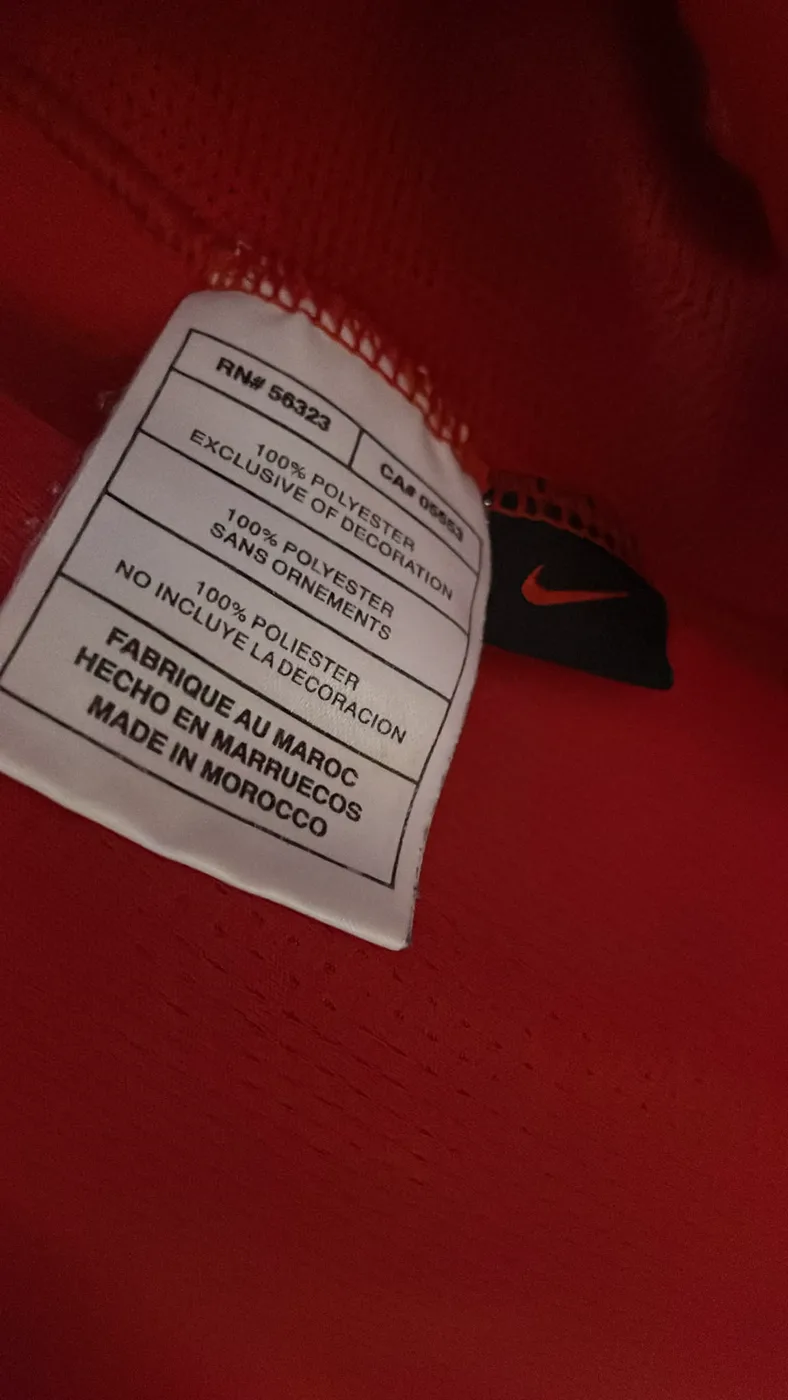
The piece documented by Tifoso Infinito is an original Manchester United Nike retail shirt, size L, personalised RONALDO 7 with the Premier League-style graphics of the era: the number with a black outline and the Premier League lion at the base of each digit. The front features the club crest, the Nike swoosh and the AIG sponsor; the neck label carries the NikeFIT DRY marking and size L, while the composition label confirms 100% polyester and production in Morocco. The garment is in excellent overall condition given its age. This is an original Nike shirt made for public retail sale: it is not presented, and should not be understood, as a match-worn, match-issued or player-issue shirt, and it is in no way indicated as having belonged to or been worn by Cristiano Ronaldo. It is a supporter's shirt, original and of the period — the story told above concerns the model and the season, not the provenance of this specific piece.
No one would mistake this shirt for a piece of match-worn memorabilia, and that is not how it should be presented. And yet it is precisely in its nature as a retail shirt, made for the public, that its editorial value lies: it is the kind of garment supporters really wore, in the stands and beyond, while Ronaldo became the best player in the world with that number on his back. Match shirts tell the story of who wore them on the pitch. This one tells the story of who wore them on the terraces — and that is also why it remains one of the most immediate symbols of one of the most important seasons in Manchester United's recent history.