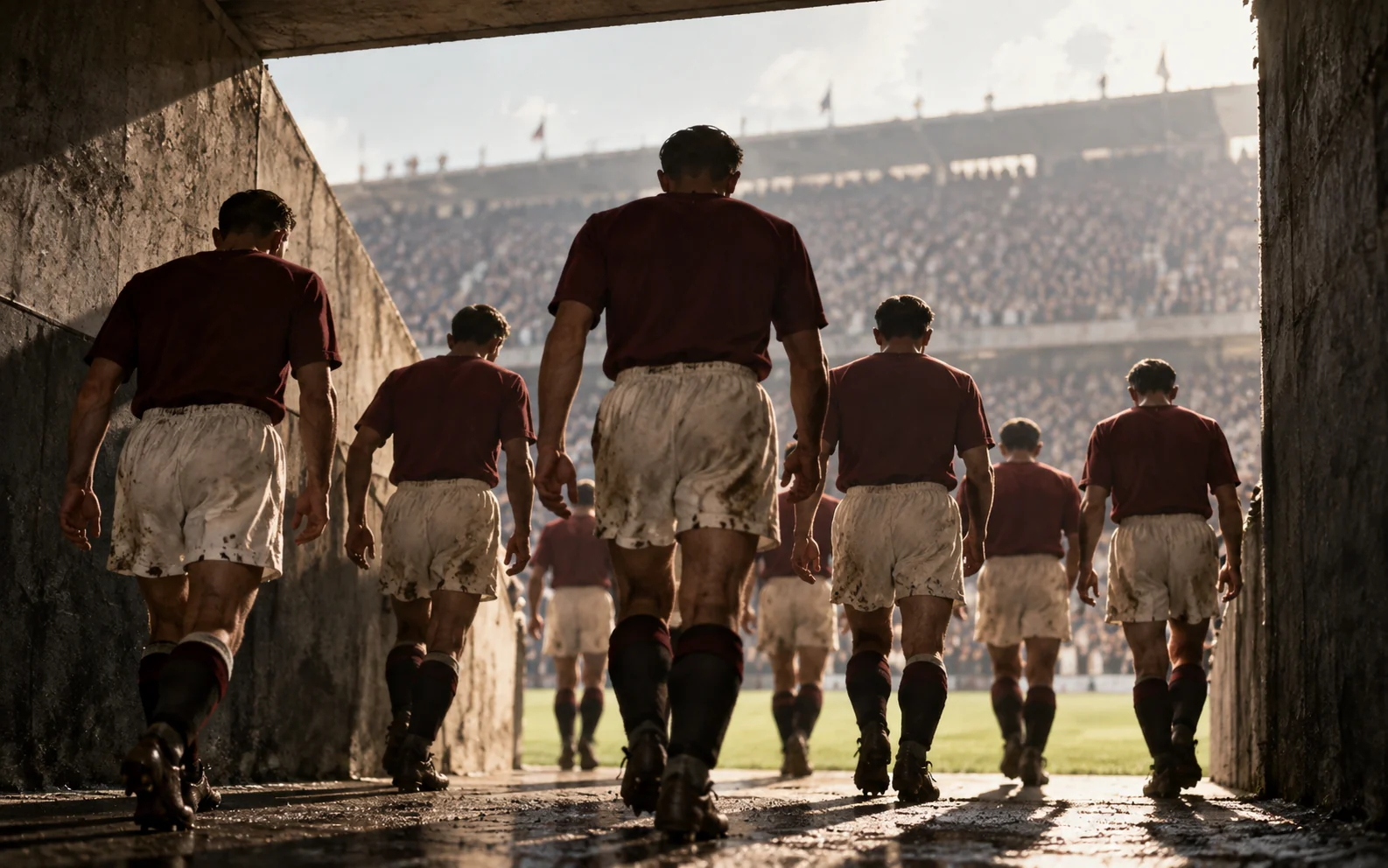
Before it became a tragedy, the Grande Torino was a sound.
It was the sound of the Filadelfia, the ground in Turin's Borgo Filadelfia, opened in 1926 and enlarged in 1932 to hold around 30,000: a compact stadium where the crowd sat close to the pitch and you could hear a match before you saw it.
It was the sound of a team that, at some point in a game, seemed to change gear. The ball moved faster, the pitch shrank, opponents fell back. Supporters had a name even for that moment: the granata quarter-hour.
We all know how it ended. That is exactly why it helps to begin earlier: to understand why that ending hit so hard, you first have to understand what the team was while it was playing.
This is the story of how Ferruccio Novo and Valentino Mazzola's Torino became the Grande Torino. And why that name still means more than a football team.
Ferruccio Novo and a team built without hurry
In the summer of 1939 Ferruccio Novo, an industrialist, took over as president of Torino. He stayed until 1953.
Accounts describe him as a careful administrator rather than a rich patron. He built the club with collaborators such as Antonio Janni, Giacinto Ellena and Mario Sperone.
The results did not arrive overnight. The first title came in 1942-43, together with the Coppa Italia: Torino was the first Italian club to win league and cup in the same season.
Then the war interrupted national football: no regular championship was played in 1943-44 or 1944-45. When the league resumed, Torino won all four post-war editions: 1945-46, 1946-47, 1947-48 and 1948-49. Five titles in all.
One of the moves that changed the team came in the summer of 1942, when Valentino Mazzola and Ezio Loik arrived from Venezia for around 1.25 million lire, a sum sources describe as the highest paid in Italy up to that point.
Around them grew a group that supporters learned to recite like a line-up: Bacigalupo, Ballarin, Maroso, Rigamonti, Grezar, Loik, Gabetto, Mazzola. It is more than a list of names. It shows a team with an identity people could recognise, on the pitch and off it.
The Filadelfia was home: the place where that identity was repeated every Sunday in front of a close, loud crowd that was used to winning.
Valentino Mazzola and the moment a match turned
Valentino Mazzola was the captain. Born in Cassano d'Adda in 1919, he played as a left-sided inside forward, but sources describe a player who covered the whole pitch: technique, stamina, a shot, and the ability to use both feet.
He was also the player the team looked to when the rhythm needed to change. The numbers give a sense of that Torino: 29 goals for Mazzola in 1946-47, when he was top scorer; 104 team goals in 38 matches that season and 125 in 40 the next. On 2 May 1948 Torino beat Alessandria 10-0, still the biggest win in Serie A history.
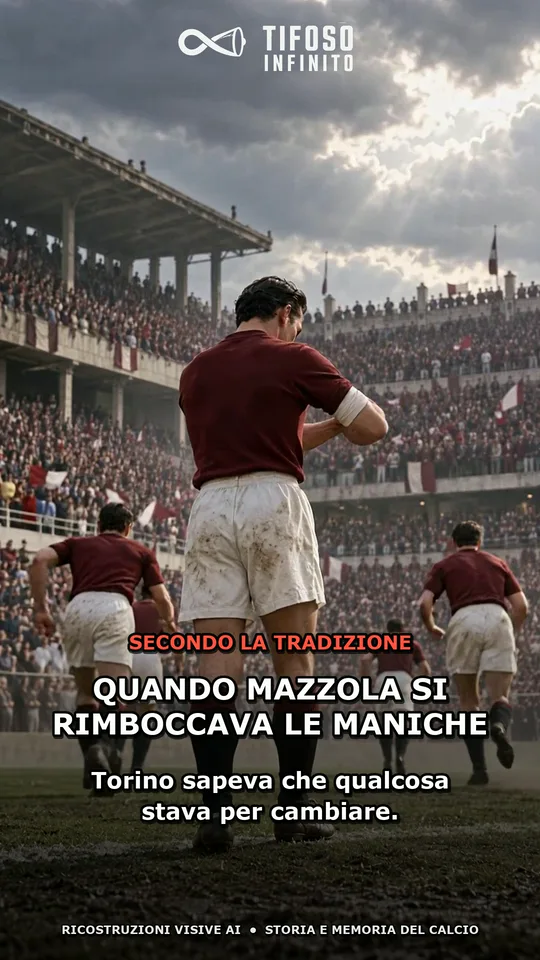
Then there is the gesture. The story goes that when a game was going badly, a trumpet from the stands, played by Oreste Bolmida, a station master at Porta Nuova, gave the signal, and Mazzola rolled up his sleeves. That was supposedly how the granata quarter-hour began: fifteen, twenty minutes in which opponents could no longer breathe.
It should be said plainly: this is a story handed down, which entered collective memory through reporters and supporters. The trumpeter belongs to Torino's history, and a cornet is kept in the Museo del Grande Torino; the quarter-hour is part of how the team is remembered. But we know of no document that places the ritual, in the form it is told, at a specific match. So we treat it for what it is: a tradition, not a fact.
Even without the gesture, the description stands: a team able to raise the tempo until the opponent broke. It is one of the reasons the side is remembered for how it played, and not only for how it ended.
When Torino became almost Italy
On 11 May 1947, at the Stadio Comunale in Turin, Italy played Hungary. Coach Vittorio Pozzo fielded ten Torino players out of eleven.
The only exception was the goalkeeper, Lucidio Sentimenti of Juventus. The other ten were all granata: Ballarin, Maroso, Rigamonti, Grezar, Castigliano, Menti, Mazzola, Ferraris II, Loik and Gabetto.
Italy won 3-2. Gabetto scored twice and Loik once; for Hungary, a twenty-year-old Puskás scored from the penalty spot.
Two weeks earlier, against Switzerland, nine Torino players had started. In May 1948, against England, there were seven.
There is no need to call them "the greatest team ever", a claim nobody can prove. The figure is enough: in an Italy that was starting to play again, Torino supplied almost the entire national side. And, as far as the sources show, no other club has matched it since.
An Italy starting again
In 1945 the war was over, but the work was not. Bombed cities, an economy to rebuild, a country divided by years of war and civil war. The first post-war title, in 1945-46, came in the year Italians voted to choose between monarchy and republic.
In that setting football was already a popular phenomenon, one of the places where thousands of people gathered every week.
That is perhaps why, in many tellings, the Grande Torino became the sign of a country getting back on its feet: a team that kept winning just as Italy was trying to stand up again. It remains an interpretation, and like all interpretations it has limits. No document tells us what millions of people really saw in Torino, and many of them followed other colours.
The facts allow something simpler. That Torino won, filled the national side, and managed to reach beyond its own supporters, as the reaction to its loss would show. In a country looking for fixed points, it was easy to see something more in that team. And it is in that "more", even before the trophies, that you can understand the echo its ending would have.
Lisbon
On 30 April 1949 Torino drew 0-0 with Inter. Four matches remained and the lead over the Nerazzurri was four points: the title was close.
A few days later the team flew to Lisbon for a friendly against Benfica. The match was organised in honour of Francisco Ferreira, the Portuguese side's captain and, according to some accounts, to help him financially.
It was played on 3 May at the Estádio Nacional in Jamor, near Lisbon. Benfica won 4-3. It was a friendly, and the score was the last thing that mattered.
The next day, 4 May, the squad set off for Turin on a Fiat G.212 operated by Avio Linee Italiane. A refuelling stop in Barcelona, then the flight home.
4 May 1949
At 5.03 pm on 4 May 1949 the aircraft crashed into the rear embankment of the Basilica of Superga, on the hill above Turin.
According to accounts of the time, the 4.55 pm weather report spoke of clouds almost touching the ground, heavy showers, strong gusting wind and visibility of around 40 metres.
The causes have been debated for a long time. The most widely accepted account is of a flight into terrain in near-zero visibility.
All 31 people on board died: 18 players, 3 coaching staff, including Ernő Erbstein and Leslie Lievesley, 3 club officials, 3 journalists and 4 crew members.
On 6 May, at the funeral, the streets of Turin filled: estimates range from 500,000 to more than 600,000 people. Around the days of the funeral the Federation declared Torino champions of Italy.
The last four league matches were played by the club's youth players against opponents who also fielded their youth sides. Torino finished ahead of Inter.
Why we still call it the "Grande Torino"
Torino, as a club, carried on. The Grande Torino, as a team, ceased to exist on 4 May 1949. And yet we keep saying its name.
On 26 May 1949, at the Stadio Comunale in Turin, River Plate played a benefit match against a "Torino Simbolo" made up of players from other clubs, among them Juventus's Giampiero Boniperti. It ended 2-2. The proceeds went to the victims' families.
Memory then passes through specific places. At Superga, every 4 May, a Mass is held and the names of the 31 who died are read out. The Filadelfia, partly demolished in the late 1990s and left abandoned for years, has been rebuilt as a sports centre, opened in May 2017. In Grugliasco, the Museo del Grande Torino e della Leggenda Granata keeps, among other things, the trumpeter's cornet and parts of the aircraft.
It passes through families too. On 4 May 1949 Sandro Mazzola, Valentino's son, was six. He would become a legend of Inter and the national team. That is enough to remind us that the story of the Grande Torino did not end with the people on that plane.
"Grande" is not a statistic. It is an adjective that settled on the name over time, and it says that we remember that team as something larger than its trophies.
Perhaps, then, the question is not how the Grande Torino ended. It is why, more than seventy-seven years later, we still call it by that name.