There was a time when a glance at the number on a player's back told you who was supposed to invent something.
That number was the 10.
He was the player the team trusted with the hardest part of the game: the final pass, the move nobody else could see.
Then football changed. The number stayed on the shirts, on the posters, in the memories. The place on the pitch did not.
This is the story of a number that was first a role and then a symbol. And of what happened to the duties that came with it.
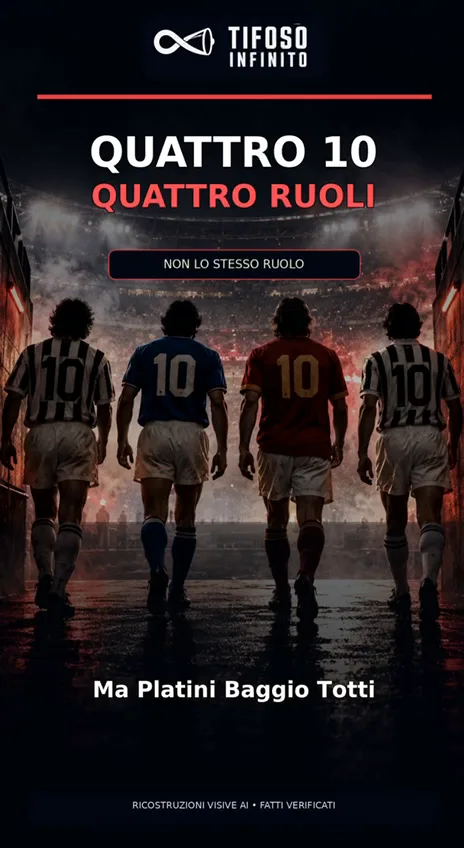
When the 10 was a trade
Shirt numbers were not created to celebrate stars. They were created to identify positions.
In 1928, in England, Arsenal and Sheffield Wednesday took the field with numbered shirts. From the 1939–40 season the Football League made numbers compulsory.
The numbering followed the 2-3-5: the goalkeeper was 1, the full-backs 2 and 3, the half-backs 4 to 6, the forwards 7 to 11. The 10 was the inside left: the forward who played alongside the centre-forward and fed him with passes.
When the WM formation pulled the inside forwards back, they became attacking midfielders, the players who supplied the centre-forward and the wingers. The 10 was already a trade: working between midfield and attack, and connecting the two.
Then came the 1958 World Cup. Brazil had not assigned numbers to their players, and FIFA did it for them. A seventeen-year-old was given the 10: his name was Pelé. In the final on 29 June he scored twice against Sweden and Brazil won 5–2.
From then on, in the popular imagination, the 10 stopped being just a slot on the team sheet and began to become an idea. That is our reading, not a rule, but it helps explain why that number ended up carrying more meaning than the others.
Platini: the 10 who ran the game
In 1982 Michel Platini joined Juventus from Saint-Étienne and took the 10 that had belonged to Liam Brady.
He was not a pure striker and not a simple midfielder. He was a creator who scored.
The numbers capture that double role. He was Serie A's top scorer three seasons running, from 1982–83 to 1984–85, and he won the Ballon d'Or in 1983, 1984 and 1985.
1984 was his most complete year. With Juventus he won the league title and the Cup Winners' Cup. With France he won the European Championship, scoring nine goals in five matches: a tournament record that nobody has beaten. In the final in Paris on 27 June against Spain, he broke the deadlock with a free-kick.
This is the 10 in its fullest form: the player who builds the move and finishes it. It is, of course, a reading, but the numbers support it.
Baggio: the talent that didn't fit the boxes
Roberto Baggio joined Juventus from Fiorentina in 1990, in a transfer that was a world record at the time. At Juventus he wore the 10 that had once been Platini's.
Sources describe him as a second striker or an attacking midfielder. That two labels are needed already says something.
In 1993 he won the Ballon d'Or. At the 1994 World Cup he took Italy to the final, with five goals in the knockout rounds, and FIFA gave him the Silver Ball. The final, on 17 July against Brazil, went to penalties. Baggio missed the last one: the ball flew over the bar.
But another episode from that tournament says more about his relationship with the boxes. On 23 June, against Norway, Italy were reduced to ten men when goalkeeper Pagliuca was sent off in the 21st minute. One minute later, Sacchi took Baggio off to bring on Marchegiani. Italy won 1–0.
It made sense: they needed a goalkeeper. But that substitution holds the tension of the whole story: the balance of the team on one side, a talent who lives between the lines on the other.
Baggio wasn't a 10 who came with a formation. He was a 10 who came with a problem to solve: where to put him, what to ask of him, without losing what made you want him on the pitch.
Del Piero: when the 10 started to move
Alessandro Del Piero joined Juventus in 1993. In November 1994, after Baggio was injured, he found a place in attack alongside Vialli and Ravanelli.
In 1995 Baggio left Juventus for Milan, and for the 1995–96 season the 10 passed to Del Piero.
In Marcello Lippi's 4-3-3 he played on the left of the attack and cut in towards the box.
That produced his most recognisable move: the curling shot from the left corner of the area towards the far post. The phrase "gol alla Del Piero" was coined in 1995–96.
It's a different kind of 10: not starting behind the strikers to serve them, but starting wide and arriving inside the box. That, too, is our reading: a 10 closer to goal.
In 2012 he left Juventus holding the club's records for appearances and goals.
Totti: from the 10 to the false nine
Francesco Totti made his Serie A debut on 28 March 1993, aged sixteen, with Roma. He stayed until 2017: his whole career at one club.
He wore the 10, and for years he was described as a trequartista or a second striker.
Luciano Spalletti arrived in June 2005. During that season Roma moved to a 4-2-3-1 that in practice worked without a true centre-forward; it would come to be called a 4-6-0. Totti played up front. "False nine" is the label that came later.
That year he scored 15 league goals. The following year, 26: Serie A top scorer and winner of the 2007 European Golden Shoe.
It wasn't a one-season episode. Under other coaches, too, Totti went back to playing as a false nine more than once.
Nor did the false nine begin with him: in the early 1950s Hungary used Nándor Hidegkuti as a withdrawn centre-forward.
Totti shows one thing clearly: the position changed, the mission didn't. Seeing first, connecting, deciding. He simply carried it into the box, where the centre-forward used to stand. This, too, is a reading.
Where did the number 10 go?
Today's football hasn't stopped producing creative players. It has changed the space in which they can be creative.
Defences have become more compact, pressing is the job of the whole team, and a 10 can no longer wait for the ball between the lines without joining the work off it. Descriptions of the role speak of an attacking midfielder with more defensive duties than in the past, and of systems such as the 4-2-3-1 and 4-3-3 that often spread creativity across several players.
As early as 2012, the journalist David Owen argued that the 10 hadn't died out but had moved back towards his own goal, with deep-lying playmakers such as Pirlo and Xavi in mind.
Our reading is slightly different: there isn't one place where the 10 went. Its duties were distributed.
The trequartista, when there is one, has more work to do without the ball. The second striker drops to collect it. The false nine brings creation inside the box: Spalletti's Roma did it with Totti, Guardiola's Barcelona with Messi, Spain with Fàbregas in the 2012 European Championship final. The creative midfielder receives in the space between centre and flank and plays forward. The attacking winger cuts in and looks for the decisive move.
The number stayed. The role changed.
The number is still on the shirts. But anyone watching the game knows the final pass can start with a midfielder, a winger cutting inside, a forward dropping to collect the ball.
There is no longer a single address for imagination. There are several players who carry it onto the pitch, in turn.
So perhaps the question isn't who was the last true 10.
Has the number 10 really disappeared, or has it simply stopped occupying a single place on the pitch?